A seized return roller can look like a minor defect until it heats the belt, damages a splice or forces an unplanned stoppage. In high-throughput tunnelling, civil, mining and processing operations, conveyor idler replacement is not simply a parts task. It is a controlled maintenance activity that protects belt life, maintains tracking and prevents a local component failure from becoming a schedule issue.
The right response depends on the idler’s location, the belt condition, access constraints and whether the conveyor can be safely isolated. A noisy idler on an accessible surface conveyor may be changed during a planned maintenance window. A failed troughing idler beneath a loaded belt in a tunnel requires a different level of planning, competent personnel and clear control of stored energy.
Recognise an idler failure before it escalates
Idlers fail in more ways than a complete bearing seizure. Bearing noise, vibration, shell wear, a damaged seal, a bent shaft or a roller that has stopped turning can all affect belt performance. Material build-up around return idlers can also create belt contact and tracking problems, particularly where wet spoil, fines or carryback are present.
Routine inspections should focus on what is changing, rather than only what is visibly broken. An idler running hotter than adjacent rollers, repeated belt-edge wear in one section, rubber dust below the belt or an increase in drive load can indicate a developing issue. On long systems, inspection records help maintenance teams identify recurring locations and determine whether the cause is component quality, loading, tracking, impact or contamination.
A failed idler should not be treated in isolation. If several rollers in the same area have short service lives, replacing them one at a time may restore operation without resolving the underlying problem. Check belt alignment, skirtboard set-up, transfer loading, structure condition and cleaning performance before closing out the work.
Plan conveyor idler replacement around the real risk
The job plan needs to match the operating environment. Underground conveyor work commonly involves restricted access, poor visibility, moving plant interfaces and limited room to handle components. The replacement method must account for the conveyor’s isolation points, take-up arrangement, belt tension, lifting requirements and the route for removing the damaged idler and bringing in the replacement.
Before work begins, confirm the correct idler assembly. This includes roller diameter and face length, shaft size, bearing and seal arrangement, bracket or frame type, trough angle and intended duty. A roller that physically fits may still be unsuitable if its load rating, environmental sealing or shaft configuration differs from the original design.
The work scope should also establish whether a single roller, a complete troughing frame, a return frame or an impact assembly is being changed. Replacing only one roller can be efficient where frames are sound and standard components are available. Where brackets are bent, frames are corroded or mounting centres have moved, changing the assembly may be the safer and more durable repair.
For higher-risk replacements, the pre-start should clearly address:
- isolation, lockout and verification of zero energy;
- belt restraint and the effect of gravity or take-up tension;
- access, lighting, communication and exclusion zones;
- manual handling or lifting equipment requirements; and
- inspection and test requirements before the conveyor returns to service.
These controls are not paperwork for its own sake. They prevent the most serious risks associated with working around conveyor belts, rotating equipment and suspended or tensioned components.
Isolate, prove and control the belt
Stopping a conveyor at the control station is not sufficient. The system must be isolated under the site’s approved procedure, locked out and tested to verify it cannot start. Isolation needs to consider local and remote start stations, automatic sequences, connected plant and any energy that could move the belt after the drive is stopped.
Belt movement can be caused by gravity on inclined sections, loading changes, take-up systems or work that releases a restraint. The maintenance team must understand the conveyor design and use approved belt clamps, restraints or engineered controls where required. Never rely on an idler or a temporary hand tool to hold a belt in position.
Remove and install without damaging the belt
Once the work area is safe, clean accumulated material from the idler frame and surrounding structure. This provides a clear view of fasteners, mounting points and belt condition. It also reduces the chance of debris falling during removal or being trapped under the belt after restart.
Support or lift the belt only as far as necessary and with equipment suited to the load and available access. Excessive lifting can strain the belt, damage covers or create instability. In some locations, a purpose-designed belt lifting device is appropriate; in others, the practical solution may be a controlled, short-duration lift using approved site equipment. The method should be selected before the crew is at the conveyor, not improvised during the repair.
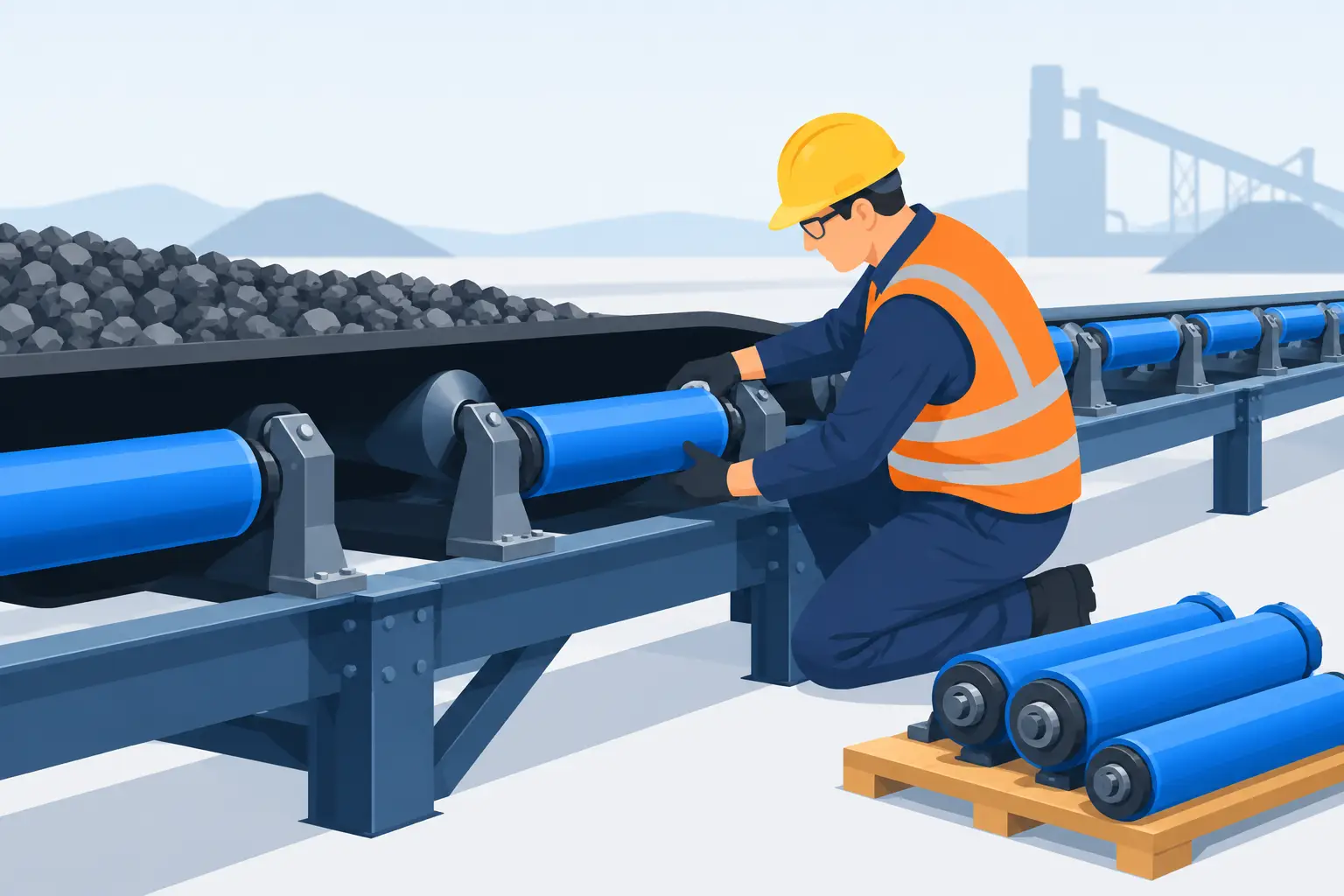
Remove the failed roller or frame carefully and inspect the mounting points as it comes out. Elongated bolt holes, cracked welds, worn brackets and distorted stringers can prevent the new idler from sitting square. Installing a new component into damaged structure often leads to poor alignment and another early failure.
Fit the replacement assembly so the roller is free to rotate and the frame is correctly seated. Fasteners should be tightened to the manufacturer’s requirements or the site-approved specification. Do not use guessed torque values, substitute bolts or unapproved modifications where engineering controls are required.
Before lowering the belt, inspect its running surface and edges for cuts, heat damage, gouging or embedded material. A seized roller may have caused more damage than is visible from the side. Identifying that damage while the system is isolated gives the project team an opportunity to plan a repair before a belt failure becomes urgent.
Verify tracking and performance after restart
The first restart is an inspection activity, not merely a handover. Remove tools and temporary restraints, confirm guards are reinstated and clear personnel from the area before the conveyor is energised. Start the system in accordance with site procedures and observe the repaired section from a safe position.
Check that the roller rotates freely, the belt remains centred and there is no contact with structure, brackets or guarding. Listen for abnormal noise and inspect the mounting arrangement for movement. If the work involved a troughing or impact frame, observe the belt through a representative loading cycle where possible. An empty belt can track differently from a loaded belt.
Record the component replaced, its location, observed failure mode and any related defects. This information supports condition-based maintenance and spare-parts planning. It also provides useful evidence when a recurring problem requires a larger corrective action, such as transfer-point modification, alignment work, a better sealing arrangement or a change in idler specification.
Build idler replacement into planned maintenance
Emergency change-outs are sometimes unavoidable, particularly on continuous infrastructure projects where conveyor availability directly affects excavation and spoil handling. However, a maintenance program that identifies worn or noisy idlers early gives teams more control over shutdown duration, labour allocation and parts availability.
Critical spares should reflect the conveyor’s actual configuration, not a generic stock list. Long-lead rollers, specialised impact assemblies, non-standard frames and components for wet or abrasive environments should be identified in advance. Sites also benefit from clear component labelling and location records, especially where multiple conveyor strings use similar-looking but incompatible idlers.
HP Rural supports conveyor maintenance and repairs with qualified mechanical personnel, component supply and rapid-response capability for demanding operational environments. For project teams, the value is not only getting an idler changed quickly. It is having the work planned, executed and verified with the same attention to safety and production continuity that the conveyor system requires.
The most effective time to deal with a failing idler is when it is still an inspection finding, with the correct part on hand and a controlled maintenance window available. That approach protects the belt, the crew and the project programme.