A stopped conveyor in a tunnel, quarry or processing plant is rarely an isolated mechanical issue. It can stop material flow, hold up crews, disrupt plant sequencing and create a growing backlog that is far harder to recover than the initial fault. Knowing how to reduce conveyor downtime starts with treating the conveyor as a critical production asset, not a piece of equipment that only receives attention when it fails.
For continuous operations, particularly underground works where access is restricted and shutdown windows are limited, reliability depends on preparation. The strongest results come from a maintenance strategy that combines regular inspection, correct installation, condition monitoring, critical spares and a proven response plan for breakdowns.
Identify the failures that cost the most time
Not every interruption has the same operational impact. A brief stoppage to clear minor carryback is different from a failed drive pulley, damaged belt or electrical fault that takes the line out for a shift. Maintenance planning should begin with a clear record of what has failed, where it occurred, how long the repair took and what production impact followed.
Reviewing this history often identifies repeating problems: belt tracking issues at the same transfer point, rollers failing in wet sections, recurring chute blockages, overheating motors or damage caused by poor loading conditions. These repeat failures should be investigated at their cause, rather than managed through repeated callouts.
A practical review should consider the equipment condition, the conveyed material, operating hours, load profile and environment. Abrasive spoil, water ingress, confined access, frequent starts and stops, and variable loading all change the maintenance requirement. A component selection that performs adequately on a surface line may not provide the same service life underground.
Build preventive maintenance around operational risk
Preventive maintenance is most effective when tasks are based on failure risk and consequence, rather than a generic calendar. High-consequence assets such as drives, take-up systems, braking equipment, primary pulleys and critical electrical controls require closer inspection and defined acceptance criteria.
Routine checks should cover belt condition and tracking, roller rotation, pulley lagging, scraper performance, guards, fasteners, structural alignment, lubrication points and material build-up. Electrical inspections should include motors, gearboxes, sensors, isolators, cables and control panels. The goal is to identify deterioration while repair work can be planned safely and completed within an available shutdown.
Inspection frequency depends on duty. A heavily loaded conveyor operating continuously through a tunnelling shift needs more attention than an intermittently used line in a low-abrasion application. Increasing inspection frequency does add labour cost, but it is generally far less expensive than losing a production shift to a preventable failure.
Make inspections useful, not just compliant
Checklists alone do not reduce downtime unless findings lead to action. Each inspection should record the location, severity, likely cause and required response. Defects should then be prioritised into immediate safety action, planned repair or monitor-and-review categories.
Clear handover between operators, supervisors and maintenance teams is equally important. Operators are often first to notice abnormal noise, belt wander, vibration, heat or changes in material flow. Giving them a simple escalation process prevents early warning signs from being lost between shifts.
Control belt tracking, transfer points and carryback
Many avoidable conveyor stoppages begin at transfer points. Off-centre loading, poor chute design, excess impact, blocked skirting and carryback can pull a belt out of alignment, damage components and create clean-up work that interrupts production.
The belt should be loaded centrally and in the direction of travel, with impact zones designed to support the belt without creating excessive friction. Skirting must contain material without being set so tightly that it accelerates belt wear. Scrapers need to be correctly tensioned and maintained, as worn or poorly adjusted cleaning equipment allows carryback to build around pulleys and rollers.
Tracking faults should not be corrected by repeatedly adjusting idlers without finding the reason for the belt movement. Misaligned pulleys, uneven loading, damaged idlers, belt damage, build-up and structural movement can all contribute. In high-demand systems, regular alignment checks after relocations, extensions or major repairs are essential.
Use condition monitoring where it changes decisions
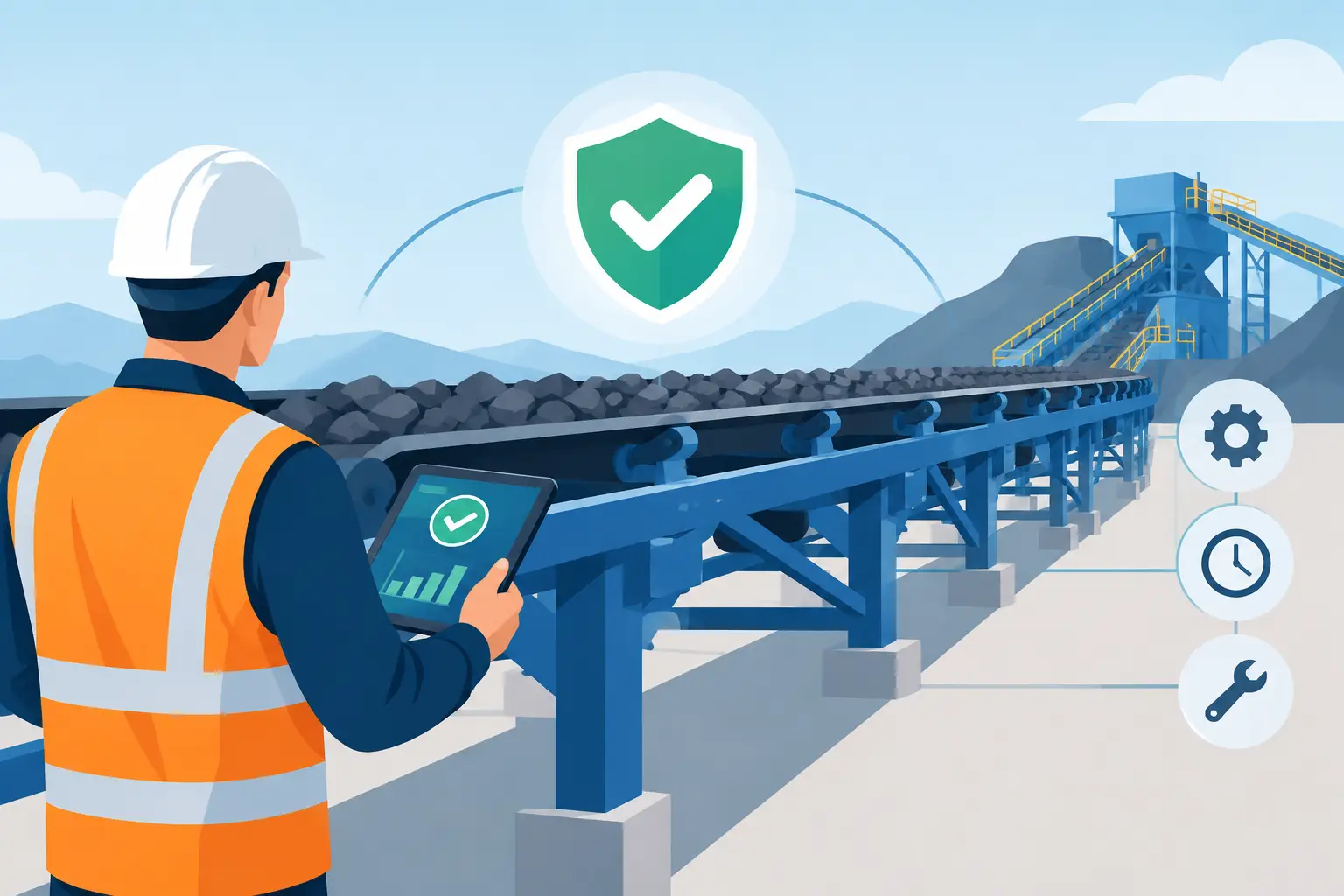
Condition monitoring helps maintenance teams move from reacting to symptoms towards planning interventions before failure. The right method depends on the conveyor and its criticality. Temperature checks can identify bearing or gearbox problems. Vibration monitoring can reveal developing mechanical defects. Oil analysis can assist with gearbox condition, while thermal imaging can detect electrical hot spots and poor connections.
Monitoring is not a replacement for physical inspections. Material build-up, torn belt covers, damaged guards and tracking problems are often visible well before they appear in a data trend. The best approach combines technician observations with targeted measurement on high-risk equipment.
Set practical trigger points for action. A reading is only valuable if the team knows when it requires further inspection, a planned repair or an immediate shutdown. This avoids collecting data without improving availability.
Hold the spares that protect production
Waiting for a standard component can turn a short repair into prolonged downtime, especially on remote, underground or project-constrained sites. Critical spares should be identified from the failure history, supplier lead times, equipment commonality and consequence of loss.
A suitable holding may include drive components, bearings, rollers, belt repair materials, pulley lagging materials, scrapers, idlers, electrical protection devices, sensors and commonly used fasteners. The exact stock level depends on the site. Holding every possible item ties up capital and can create storage issues, while holding too little leaves the operation exposed.
The most effective spare-parts strategy standardises components where practical. If several conveyors use compatible rollers, motors, gearboxes or sensors, stock can be reduced without increasing risk. Every stored item should be protected from moisture, contamination and deterioration, with stock levels checked after each breakdown or planned repair.
Plan repairs before the shutdown window opens
A planned shutdown only delivers value if the work can begin immediately. Before isolation, confirm the scope, risk controls, permits, access requirements, lifting arrangements, tools, parts and competent personnel. For conveyor repairs, this may also include belt clamps, pulling equipment, welding capability, riggers, dogmen or crane support.
Underground environments add further constraints. Restricted access, ventilation requirements, simultaneous operations and material movement routes can change the sequence of work. The repair plan must account for these conditions rather than assuming surface access and unrestricted laydown areas.
After any significant repair, commissioning checks are critical. Verify guarding, alignment, emergency stops, pull-wire switches, belt tracking, controls and loading performance before returning the system to normal duty. Rushing this stage can create a second failure shortly after restart.
Create a response plan for unavoidable breakdowns
Even well-maintained systems can fail. The difference between a controlled interruption and a major production event is usually the quality of the response plan. Define who makes the first assessment, who has authority to stop or restart the system, how specialist support is contacted, and what information is required before technicians mobilise.
The initial report should identify the conveyor location, operating condition before failure, visible damage, alarms, isolation status, access constraints and immediate safety risks. Accurate information allows the correct people, tools and parts to be deployed first time.
For critical infrastructure work, rapid-response capability should include qualified mechanical and electrical personnel who understand conveyor systems and site safety requirements. A fitter may resolve a roller or tracking issue, but a drive, controls or belt failure can require a broader crew and coordinated lifting or electrical support.
Reduce conveyor downtime through accountable support
The most reliable conveyor operations do not rely on emergency repairs alone. They establish clear maintenance responsibilities, use operating data to target repeat failures, and make sure the right technical capability is available when conditions change.
For major infrastructure and tunnelling projects, that may mean combining site maintenance teams with specialist conveyor technicians, electrical tradespeople, supervisors and labour support that can scale with the workfront. HP Rural supports this approach through conveyor installation, maintenance, repairs, component supply and responsive breakdown assistance for demanding material-handling operations.
A conveyor will always require attention in hard service. The objective is to make that attention planned, safe and efficient, so minor defects are corrected before they become the stoppage that affects the whole project.