A conveyor running beneath a tunnel heading is not simply a transport asset. It Is a moving interface between people, plant, electrical systems and continuous excavation. When a belt tracks poorly, a chute blocks or a worker enters a restricted area, the consequence can escalate quickly in confined underground conditions. The best underground conveyor safety controls are the ones that identify abnormal conditions early, stop equipment predictably and allow crews to isolate, inspect and restart the system with discipline.
There is no single control package that suits every tunnel conveyor. Belt length, material type, transfer arrangement, ventilation, access constraints, drive configuration and project operating procedures all affect the required design. A safety system must also be practical to inspect and maintain. Controls that are difficult to test, routinely bypassed or poorly understood by operators do not provide dependable protection.
Best underground conveyor safety controls start with the risk
Effective control selection begins with a task-based risk assessment, not a catalogue of devices. The assessment should consider normal production, planned maintenance, belt cleaning, spillage removal, breakdown response, belt extension and commissioning. It should also account for workers accessing transfer points, drives, take-ups, walkways and areas near the tunnel face.
Australian conveyor installations commonly need to align with relevant requirements such as AS 1755, applicable electrical standards, principal contractor rules and the project’s tunnel safety management system. However, compliance is the baseline. The operating environment determines whether additional controls are needed, particularly where visibility is limited, access is narrow and a stopped conveyor can affect the wider tunnelling cycle.
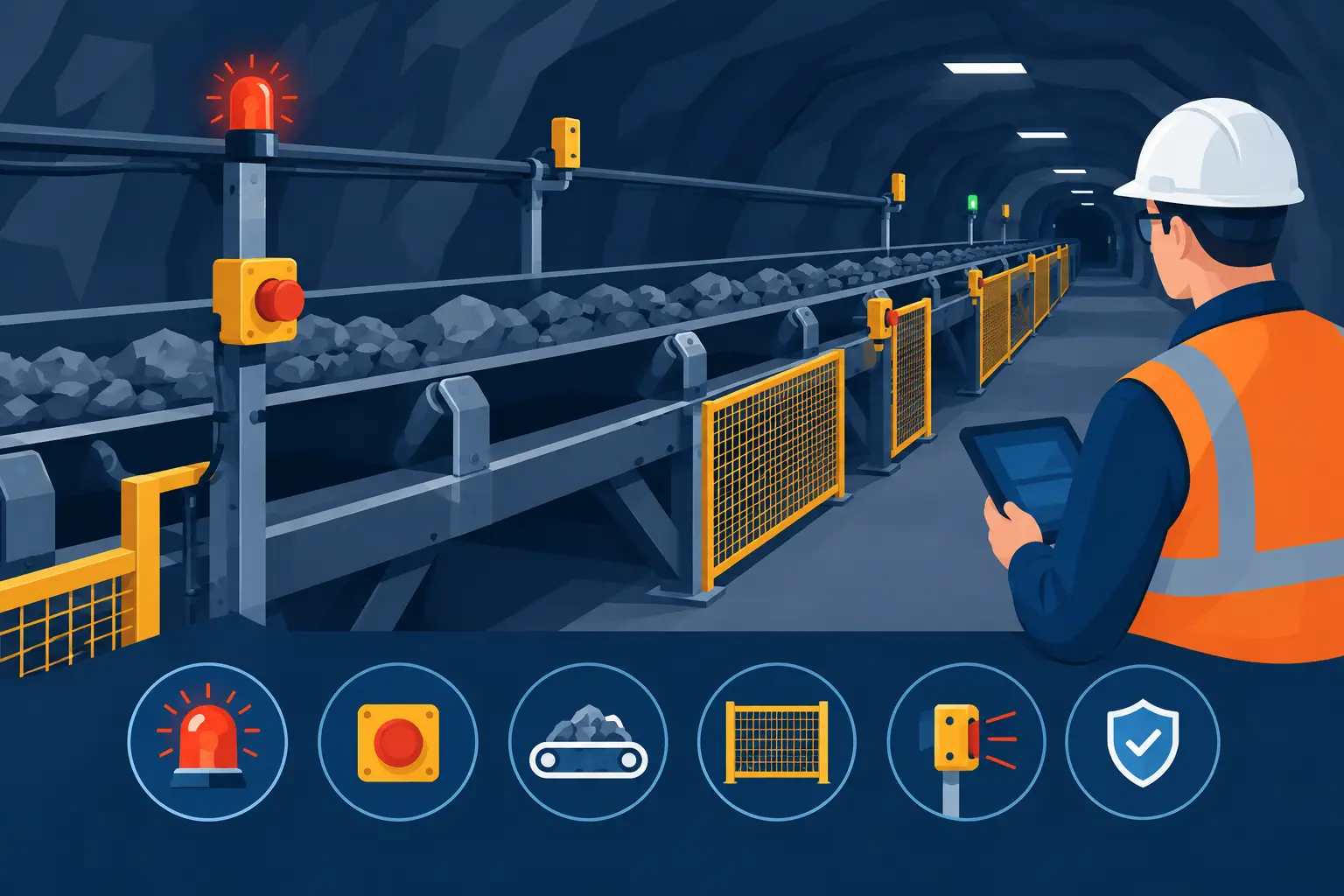
The most effective arrangements use layers of protection. Physical guarding prevents contact with moving parts. Detection devices identify a developing fault. emergency stops provide an immediate response. Isolation systems ensure stored or electrical energy cannot be released during work. Training, supervision and clear restart procedures hold those layers together.
Emergency stopping that is accessible and reliable
Emergency-stop devices must be readily accessible from locations where people work alongside the conveyor. On long underground belts, pull-wire switches provide continuous stopping capability along accessible sections, while mushroom-head emergency stops suit drives, transfer stations, take-up areas and control points.
Placement matters as much as quantity. A pull wire that is obstructed by services, difficult to reach from a walkway or left with excessive slack will not serve its purpose during a genuine emergency. Devices should be installed at a workable height, clearly identified and protected from avoidable mechanical damage without limiting access.
An emergency stop should bring the system to a safe state and require a deliberate reset before restart. It should not permit an automatic restart simply because a wire has been reset or power has returned following an interruption. Audible and visual warning before start-up is particularly valuable underground, where personnel may be working beyond the operator’s line of sight.
Regular functional tests are essential. Testing should confirm not only that the local device operates, but that the correct conveyor section stops, the fault is indicated at the control point, and the system cannot restart until the cause has been addressed and the reset sequence is completed.
Guarding and interlocks at high-risk areas
Nip points at head and tail pulleys, snub pulleys, return rollers, drive couplings and take-up equipment remain among the highest-risk locations on a conveyor. Fixed guards should prevent access during operation while allowing inspection and maintenance to be carried out safely when the equipment is isolated.
Where frequent access is necessary, interlocked guards can provide a stronger control than reliance on procedures alone. Opening an interlocked guard should stop the relevant hazardous motion and prevent restart until the guard is restored and the control system is reset. The design must consider the stopping time of the belt and any run-on from rotating components.
Interlocks are not a substitute for isolation. A worker undertaking cleaning, adjustment, repair or component replacement should use the site’s lock-out and tag-out process, verify isolation and manage all relevant energy sources. This may include electrical supply, gravity take-up energy, hydraulic pressure, pneumatic services and stored material in chutes or hoppers.
Fault detection that prevents damage becoming an incident
Condition monitoring and shutdown devices are central to safe, reliable underground conveying. Their purpose is not only to protect the belt and structure. Early fault detection limits the need for workers to respond in hazardous areas while material continues to move.
The appropriate combination depends on the conveyor layout, but the controls most commonly considered include:
- belt misalignment or drift switches at locations where mistracking could damage the belt, structure or guarding
- belt slip and zero-speed monitoring to identify loss of drive traction or unexpected belt stoppage
- blocked-chute switches at transfer points to prevent material build-up and spillages
- belt rip detection where sharp or oversized material creates a credible risk of major belt damage
- bearing temperature, vibration or other drive-condition monitoring where failure could lead to overheating or loss of containment
- fire detection and suppression arrangements suited to the belt, drives, electrical equipment and tunnel fire strategy.
These devices need sensible trip logic. A highly sensitive switch that stops production repeatedly for minor movement can encourage nuisance bypassing. Conversely, a setting that tolerates excessive belt drift may allow a small issue to become a belt tear, fire risk or structural failure. Set points should be established through commissioning, reviewed against operating data and changed only through controlled engineering and management processes.
Controls at transfer points and loading zones
Transfer stations deserve particular attention because they combine moving belts, falling material, dust, noise and regular maintenance activity. Good chute geometry, skirt sealing and correctly designed impact support reduce spillage at the source. That improves safety by reducing manual clean-up near moving equipment.
Blocked-chute detection should be positioned to identify material accumulation before it backs up into the preceding conveyor. Where a stoppage occurs, the control sequence should prevent continued feeding from upstream equipment. Interlocking conveyors in the correct order avoids overloading transfer points and gives operators a clear response when a downstream fault develops.
Dust suppression and extraction can also form part of the control strategy. Reduced visibility and airborne dust make inspection harder, affect operator awareness and can contribute to fire and respiratory risks. The solution must be compatible with tunnel ventilation, material characteristics and electrical equipment ratings.
Isolation, communication and safe restart
Many serious conveyor incidents occur during intervention rather than routine operation. A good safety system therefore gives equal weight to isolation and communication. Isolation points should be identifiable, accessible and capable of being locked by the people carrying out the work. Complex systems may require a documented isolation plan that covers multiple drives, upstream feed equipment and any energy held in take-up arrangements.
Before maintenance begins, crews need a clear handover: what failed, which belt sections are affected, where personnel are working and who controls the restart. Radios, fixed communication points and control-room status indications all have a role underground. Visual confirmation remains necessary where communication is interrupted or access is restricted.
Restart should be treated as a controlled activity, not an administrative afterthought. The area must be inspected, guards returned, tools and personnel cleared, isolations formally removed by authorised people and warnings activated before motion begins. On multi-conveyor systems, the sequence should ensure downstream belts are available before upstream belts discharge material.
Commissioning and maintenance make controls dependable
Safety controls are only as reliable as their installation, testing and ongoing maintenance. During commissioning, each emergency stop, pull wire, guard interlock, drift switch, speed monitor, alarm and trip sequence should be functionally proven and recorded. Control drawings, cause-and-effect documentation and operator instructions should match the equipment actually installed.
Preventive maintenance should include inspection for damaged cables, contaminated switches, corroded brackets, loose pull wires, missing guards, worn rollers and ineffective signage. Underground vibration, moisture, dust and belt movement can steadily degrade devices that passed testing at handover.
It is also worth reviewing trip and fault history. Repeated drift alarms may point to loading problems, worn idlers or structural alignment issues. Frequent blocked-chute trips may indicate a transfer design limitation rather than an operator problem. Treating recurring safety-device activations as useful operating data helps remove the underlying cause.
For major tunnel works, HP Rural supports conveyor installation, commissioning, maintenance and rapid-response repairs with technicians who understand the operational pressure around continuous material movement. The practical objective is a system that protects crews without introducing avoidable downtime or complicated maintenance burdens.
The right safety controls are those that crews can access, test and trust when conditions change. Build them into the conveyor from design through to daily operation, and every stop becomes more controlled, every restart more deliberate and every shift better prepared for the work ahead.