A conveyor guard that is difficult to remove safely will eventually be bypassed, damaged or left off after maintenance. In a tunnelling heading, transfer station or processing plant, that creates an exposure no project can afford. The best conveyor guarding options are therefore not simply the strongest barriers available. They are systems that prevent access to nip points and rotating equipment while allowing trained crews to inspect, clean and maintain the conveyor without unnecessary delays.
For project managers and maintenance supervisors, the decision has direct consequences for worker safety, availability and programme certainty. Guarding must suit the machine, the task, the surrounding space and the way the conveyor is actually operated. A standard panel arrangement may be adequate on an accessible surface conveyor but unsuitable around a confined underground drive station where access, ventilation, dust and emergency response all need consideration.
What effective conveyor guarding must achieve
Conveyor guarding is intended to stop people reaching hazardous moving parts, including head and tail pulleys, bend pulleys, snub pulleys, drive components, take-up units, return rollers and pinch points. It must remain secure in service, withstand the local operating environment and provide an appropriate level of protection against accidental contact.
The practical test is whether a person can reach a danger zone during normal operation, cleaning, inspection or foreseeable upset conditions. Guarding should account for material spillage, belt tracking issues and the tendency for loose clothing, tools or hands to be drawn towards a moving belt or rotating component. It also needs to work with the site’s isolation and lock-out procedures. A guard is not a substitute for isolation when maintenance is required.
Good guarding design also supports the people responsible for keeping the plant running. If routine inspection points are hidden behind heavy fixed panels, crews may lose time opening guards or skip checks altogether. The safer arrangement is often a combination of fixed physical protection, controlled access and inspection provisions located where they are needed.
Best conveyor guarding options by application
There is no single best guard for every conveyor. The following options are commonly combined to build a practical guarding solution.
Fixed mesh guards for pulleys and rollers
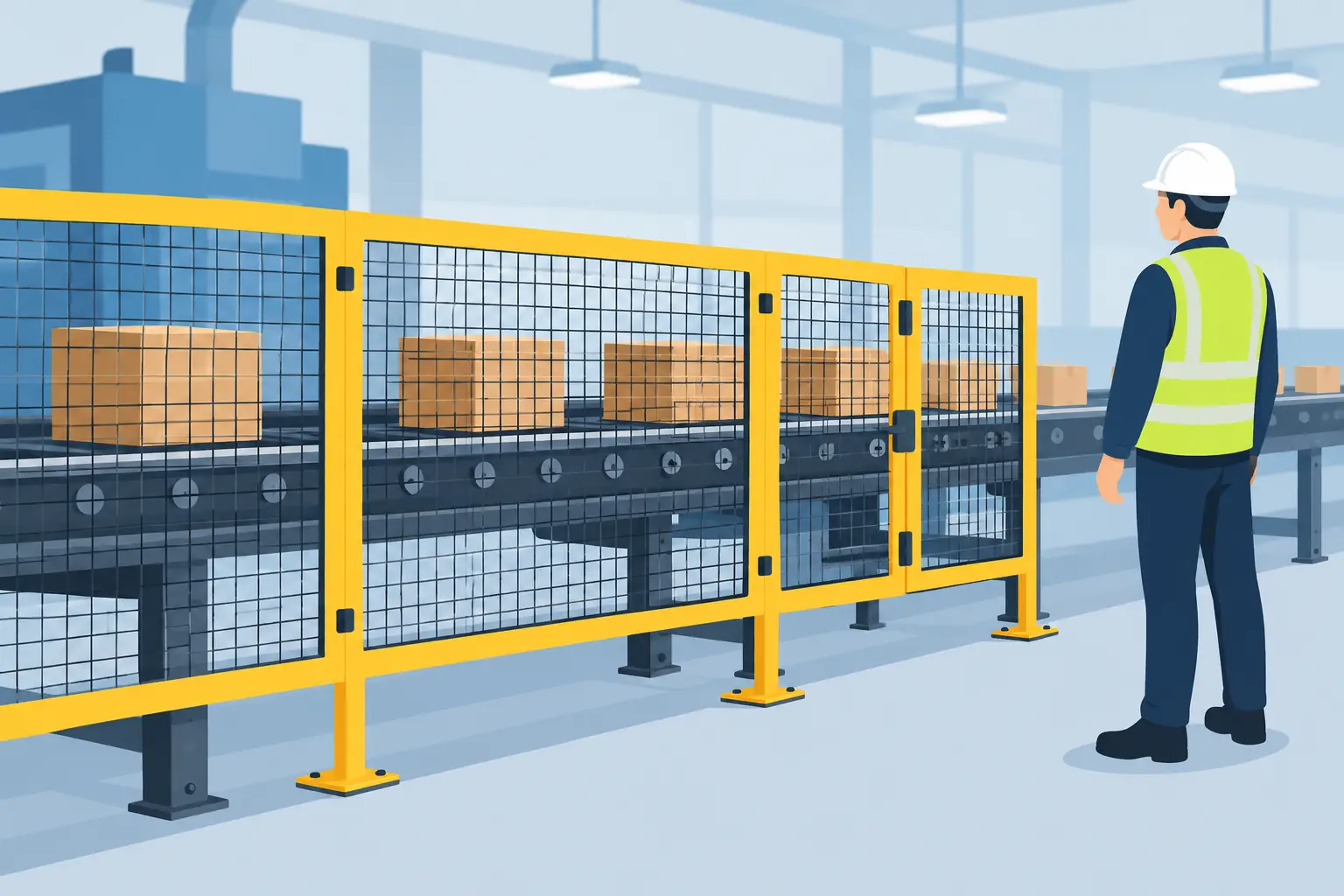
Fixed mesh guarding is a dependable option around head, tail, bend and snub pulleys, as well as other rotating components. Mesh provides a physical barrier while retaining visibility for inspection. It can help operators identify belt tracking problems, material build-up and roller failures before they become larger faults.
The mesh aperture, stand-off distance, frame strength and fixing method all matter. A panel that can flex inward under impact may not maintain safe clearance from the hazard. In wet, abrasive or corrosive conditions, material selection and coatings should be matched to the environment to avoid premature deterioration.
Fixed guards are well suited to areas that do not require frequent access. Where access is necessary, fittings should be designed so removal requires a deliberate action and can be managed under the site’s isolation procedure. Loose, improvised or damaged panels should never be accepted as a permanent condition.
Hinged and interlocked access guards
Hinged guards improve access to equipment requiring regular inspection or adjustment. They can reduce manual handling compared with lifting off large panels and help ensure the guard is returned to its correct position after work is complete.
Where opening a guard exposes a person to a moving hazard, an interlocked guard may be appropriate. The interlock is arranged to stop or prevent operation when the guard is opened. This can provide an additional layer of control, but it must be selected and installed as part of the wider control system. Interlocks require testing, inspection and protection from damage or unauthorised defeat.
Interlocking is particularly valuable around drives, high-risk transfer areas and equipment where access during operation could otherwise occur. It does not remove the requirement for formal isolation before maintenance, clearing a jam or entering a hazardous area.
Full-length side guarding and return roller protection
Long conveyor runs can expose workers to carry and return roller nip points, especially where walkways, work platforms or access routes run alongside the belt. Full-length side guarding or return roller guards can prevent inadvertent contact while still allowing visual inspection of the belt line.
This option needs careful design around emergency access, belt drift and cleaning requirements. Guards set too close to the belt can trap spillage and complicate housekeeping. Guards set too far away may leave an unacceptable reach-through risk. On underground conveyor systems, the arrangement should also allow personnel to move safely through restricted spaces without creating snagging points or obstructing egress.
Drive guards and coupling protection
Motors, gearboxes, couplings, shafts, belts and chain drives require purpose-built protection. These are high-energy components, often located in areas where maintenance personnel work frequently. A correctly engineered drive guard should cover rotating parts and prevent access from all reasonably foreseeable approaches, not only the most obvious side.
Removable drive covers may be necessary for lubrication, condition checks and alignment work. The design should consider how the cover is handled, where it is placed during maintenance and whether its fasteners can be retained. A cover that needs two people to manage in a tight plant room may introduce a manual handling problem that was avoidable at the design stage.
Perimeter fencing and controlled access zones
For large drives, take-up arrangements and high-traffic transfer stations, perimeter fencing can establish a controlled zone around multiple hazards. It is useful where individual component guards alone do not manage the broader risk of personnel entering an operating area.
Gates can be fitted with access control or interlocking where required by the risk assessment. The fence layout must allow maintainers enough room to work safely once the plant is isolated. It should also be coordinated with walkways, firefighting equipment, emergency stops, lighting and evacuation paths. Perimeter fencing that restricts emergency movement or blocks inspection access is not an effective solution.
Choosing guarding for tunnelling and high-demand sites
Tunnel conveyors present conditions that deserve more than a catalogue selection. Space constraints, frequent extensions, wet and abrasive spoil, low visibility, changing interfaces and continuous production all influence the best approach. Guards may need to be modular so they can be removed and reinstated efficiently as the system changes. They also need durable fixings that tolerate vibration and can be inspected in restricted access conditions.
At transfer points, guarding should be considered alongside skirt sealing, dust control, chute access and spill management. A guard that conceals recurring spillage can delay fault identification. Conversely, an open arrangement that improves visibility but leaves a reachable nip point is not acceptable. The solution is usually engineered access: guarded viewing zones, safe inspection points and defined isolation procedures for any hands-on work.
For major civil and infrastructure projects, design review should involve operations, maintenance, mechanical engineering and safety personnel. The installation crew often sees practical issues that are not apparent in drawings, such as a guard clashing with a service route or restricting access to a belt cleaner. Resolving these issues before commissioning avoids rushed modifications later.
Installation quality matters as much as guard type
The most suitable guard will not perform as intended if it is poorly installed. Frames must be adequately supported, edges finished to avoid cuts and snags, and fasteners selected for the vibration and environment. Guard panels should not rattle loose, sag towards moving equipment or rely on temporary restraints.
Clear labelling assists safe operation. Areas requiring isolation before access should be identified, and warning signage should remain legible in dusty, wet or abrasive environments. Emergency stops must stay visible and reachable. Guarding cannot be allowed to obscure critical controls or reduce a worker’s ability to react to an incident.
Commissioning provides the right opportunity to verify clearances, check for fouling through the conveyor’s operating range and confirm access arrangements with the people who will maintain the system. This is also the time to record guard locations and inspection requirements in maintenance documentation.
Maintain guards as safety-critical equipment
Guards are often damaged by impact, vibration, corrosion, material build-up and repeated removal during fault response. Treating them as incidental steelwork allows small defects to become normalised. A missing fastener, bent mesh section or improvised opening can materially change the risk at a conveyor.
Routine inspections should check guard security, clearances, hinges, latches, interlock function, corrosion and signs of contact with the belt or rotating parts. Defects need prompt rectification, particularly where protection at a nip point has been compromised. Spare panels, fixings and interlock components should be considered in site spares planning for critical conveyors.
HP Rural supports conveyor installations, modifications, maintenance and breakdown work in demanding material-handling environments. When guarding needs to be altered to improve access or address a recurring operating issue, the change should be assessed as part of the conveyor system rather than treated as an after-hours patch.
The right guarding arrangement is one your crews can trust: secure during production, practical during maintenance and matched to the real conditions of the site. That is how safety controls help protect people without adding avoidable downtime to a critical conveyor operation.